
GST Registration: Step-by-Step Process, Documents & Fees
Starting a business comes with several legal responsibilities, and one of the most important is obtaining GST registration if your business meets the eligibility criteria. A valid GST registration allows businesses to collect Goods and Services Tax (GST), claim input tax credit, and operate in compliance with Indian tax laws.
If you are planning to start a new business or expand an existing one, understanding the GST registration process can save time and prevent unnecessary delays. This guide explains the complete process, required documents, eligibility, and common mistakes to avoid so you can register with confidence.
What Is GST Registration?
GST registration is the process of obtaining a Goods and Services Tax Identification Number (GSTIN) from the Government of India. Once registered, a business becomes legally authorized to collect GST from customers and file GST returns.
Registration is mandatory for businesses that cross the prescribed turnover threshold or meet specific conditions under the GST Act. Even when registration is optional, many businesses choose to register voluntarily to improve credibility and claim input tax credit.
For entrepreneurs looking for GST registration services in Indore, understanding the legal requirements before applying helps ensure a smooth registration process.
Who Needs GST Registration?
Not every business is required to register immediately. However, registration becomes necessary in several situations.
Businesses that generally need GST registration include:
- Businesses crossing the prescribed turnover limit
If your annual turnover exceeds the threshold notified under GST law, registration becomes mandatory. The applicable limit depends on the type of business and location. - Interstate suppliers
Businesses supplying goods or services across state boundaries may need GST registration based on applicable provisions. - E-commerce sellers
Businesses selling through online marketplaces may be required to register even if their turnover is below the threshold in certain cases. - Input Service Distributors and specific notified businesses
Certain categories of taxpayers must register irrespective of turnover due to legal requirements.
If you are unsure whether registration is mandatory, consulting a tax consultant before applying can help avoid future compliance issues.
Understanding Eligibility Before You Apply
Before initiating an application on the GST portal, clarity on eligibility is essential. Registration is mandatory when aggregate annual turnover exceeds:
- ₹40 lakhs for suppliers of goods (in most states)
- ₹20 lakhs for service providers
Lower thresholds apply to certain special category states, and there are specific circumstances where registration becomes compulsory regardless of turnover, including:
- Inter-state supply of goods or services
- Selling through e-commerce platforms
- Liability under reverse charge mechanism
- Casual taxable persons
- Non-resident taxable persons
- Input Service Distributors
Voluntary registration remains an option even below the threshold. Many startups and small enterprises choose this route to claim input tax credit and enhance credibility with clients who prefer dealing with GST-compliant vendors.
GST Registration Process in India
The GST registration process in India follows an online application system managed through the GST portal. Although the application is digital, accurate documentation is essential for successful approval.
The process generally includes the following steps:
1. Check Eligibility
Before applying, confirm whether your business is required to register under GST or if voluntary registration is beneficial for your operations.
2. Gather Required Documents
Keep all necessary documents ready before starting the application. Missing or incorrect information often causes delays.
3. Submit the Online Application
Complete the online application form by entering business details, promoter information, business address, bank account details, and other required information.
4. Verification by Authorities
The GST department reviews the submitted application. If additional clarification or documents are required, a notice may be issued.
5. Receive GSTIN
Once the application is approved, the GST Identification Number (GSTIN) is issued, allowing the business to operate as a registered taxpayer.
Although the process is straightforward, careful review before submission reduces the chances of rejection.
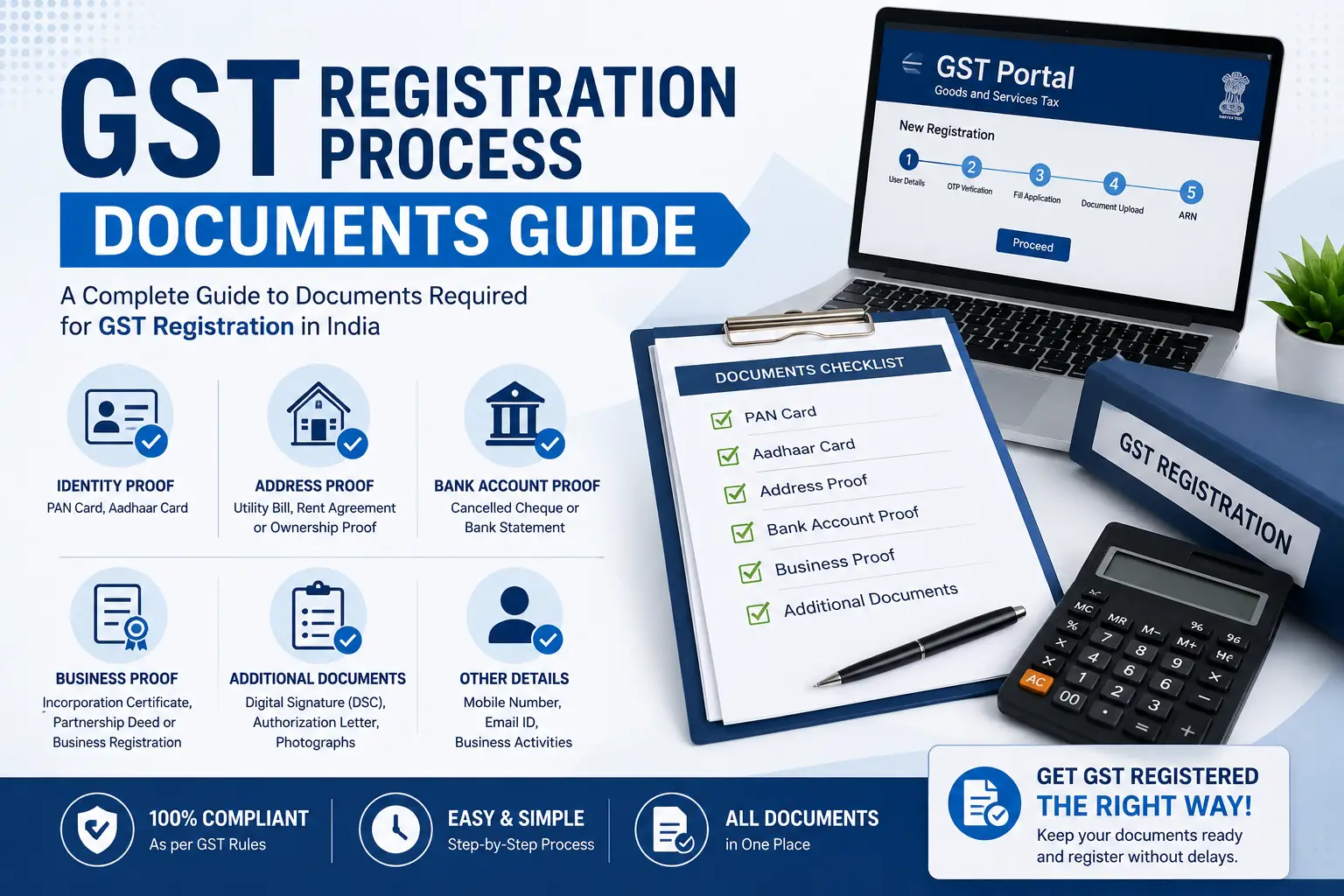
Documents Required for GST Registration
Preparing your documents in advance makes the application process much easier.
The documents required for GST registration usually include:
- PAN Card of the business or proprietor
PAN is one of the primary identification documents used during registration. - Aadhaar Card of the applicant
Aadhaar is commonly used for identity verification and authentication. - Business address proof
Depending on the nature of the premises, address proof may include ownership documents, electricity bills, rent agreements, or consent letters. - Bank account details
A cancelled cheque or bank statement is generally required to verify the business bank account. - Photographs of promoters or authorized signatories
Recent passport-size photographs may be required depending on the business structure.
Additional documents may be necessary for partnerships, LLPs, companies, trusts, or societies.
Documents for Sole Proprietorships
If you’re running your business as a sole proprietor, it’s usually the most straightforward. You’ll need:
- PAN card of the proprietor: This is your business’s primary identification.
- Aadhaar card of the proprietor: For identity verification.
- Proof of business address: This could be a rent agreement if you lease your space, or an electricity bill in your name or the business’s name. Make sure it’s recent!
- Bank account details: Usually, a cancelled cheque or a bank statement showing your business name is sufficient. This is where tax refunds or credits will go.
Required Documents for Partnership Firms
Partnership firms have a bit more to show, as you’re dealing with multiple owners.
- PAN card of the firm: The partnership itself needs its own PAN card.
- PAN cards of all partners: Each partner needs to provide their individual PAN.
- Partnership Deed: This is the legal document outlining the terms of your partnership, profit/loss sharing, and responsibilities.
- Proof of business address: Similar to sole proprietorships, this could be a lease agreement or utility bill.
- Bank account details: A cancelled cheque or statement for the firm’s bank account.
Documentation for Companies
For private or public limited companies, the documentation is more formal, reflecting the corporate structure.
- Certificate of Incorporation: Issued by the Registrar of Companies (RoC), this is proof your company is legally formed.
- Memorandum of Association (MOA) and Articles of Association (AOA): These documents detail your company’s objectives, rules, and regulations.
- PAN card of the company: The company’s unique tax identification number.
- Proof of business address: Lease agreement, utility bills, etc., for the registered office.
- Bank account details: For the company’s bank account.
- Authorization Letter or Board Resolution: This shows who is authorized to act on behalf of the company for GST purposes.
It’s always a good idea to have digital copies of all these documents ready. You’ll be uploading them during the online application process, and having them scanned and clear will make things go much smoother. Double-check that all information is current and matches other official records to avoid any delays.
Remember, having all your ducks in a row with these documents can really speed up the GST registration process in Indore. It shows you’re prepared and serious about compliance.
Timeline for Approval
After you submit your application, it goes to the GST officer for review. Typically, you can expect the approval to come through within about 7 to 15 working days. Of course, this can sometimes take a bit longer if there are any issues with your application or if more clarification is needed. Once approved, you’ll receive your Goods and Services Tax Identification Number (GSTIN) and your registration certificate, which you can then download from the portal.
GST Registration Fees
One of the most common questions business owners ask is whether GST registration involves any government charges.
The Government of India does not charge any official fee for applying for GST registration through the GST portal. However, if you choose to work with a Chartered Accountant or GST consultant, professional service charges may apply for document verification, application preparation, filing, and post-registration guidance.
Want to understand the complete GST registration cost? Read our detailed guide on GST Registration Price in Indore.
Before engaging a consultant, ask for a clear breakdown of what is included, such as document review, GST application filing, follow-up with the department, and post-registration support. This helps avoid unexpected costs and ensures you receive the services you need.
Common Mistakes That Delay GST Registration
Many applications are delayed by avoidable errors rather than by complex legal issues.
Some common mistakes include:
- Providing incorrect business information.
- Uploading unclear or incomplete documents.
- Using mismatched PAN or Aadhaar details.
- Entering an incorrect business address.
- Missing department notices requesting clarification.
Reviewing every detail before submission can significantly improve the chances of timely approval.
Benefits of Registering Under GST
Apart from legal compliance, GST registration offers several practical advantages for businesses.
Some important benefits are:
- Claim Input Tax Credit
Registered businesses can claim eligible input tax credit on business purchases, helping reduce overall tax costs. - Improved Business Credibility
Many customers, suppliers, and corporate clients prefer working with GST-registered businesses. - Expansion Opportunities
Registration makes it easier to supply goods and services across different states while meeting applicable tax requirements. - Participation in Larger Contracts
Government departments and large organizations often require vendors to have valid GST registration.
These benefits make registration valuable even for businesses that qualify for voluntary registration.
When Professional Assistance Makes Sense
While the portal allows self-registration, professional consultation becomes valuable in cases involving:
- Complex business structures
- Multiple branches
- Export or import activities
- Input service distribution
- Composite and mixed supply classification
A tax professional ensures correct tax categorisation and compliance planning.
Choosing the Right GST Consultant
Although many businesses complete the application independently, professional guidance can reduce errors and save valuable time.
When selecting a GST consultant in Indore, consider the following:
- Experience in handling different business structures.
- Understanding of current GST regulations.
- Assistance with notices or document verification if required.
- Ongoing support for GST return filing and compliance.
A knowledgeable consultant not only assists with registration but also helps businesses stay compliant after registration.
GST Registration for Small Businesses
Many entrepreneurs believe GST registration and compliance are only useful for large companies, but that is not always true.
For GST registration for small businesses in Indore, voluntary registration may offer several advantages depending on the nature of the business. Small businesses working with corporate clients, online marketplaces, or interstate customers often benefit from having a GSTIN.
Before deciding, evaluate your turnover, customer base, and future business plans with professional advice.
Conclusion
GST registration is an important step toward building a legally compliant and professionally managed business. Understanding the eligibility criteria, preparing the required documents, and following the proper application process can make the registration process much smoother.
If you need assistance with GST registration or related compliance, our team at TaxFend is here to help. We guide businesses through every stage of the registration process while ensuring applications are prepared accurately.
Ready to register your business? Contact TaxFend today to schedule a consultation or connect with our team on WhatsApp to get started.
Frequently Asked Questions
1. How long does GST registration usually take?
The processing time depends on document accuracy and verification by the GST department. Applications with complete and correct information are generally processed faster.
2. Can I apply for GST registration before starting my business?
Yes. Many entrepreneurs complete GST registration before commencing business operations, especially if registration is required for their business model.
3. Is GST registration compulsory for every small business?
No. Registration depends on factors such as annual turnover, business activities, and applicable legal provisions. Some businesses may also choose voluntary registration.
4. Can I update my GST registration details later?
Yes. Certain business details, such as address, bank account information, or authorized signatory, can be updated through the GST portal following the prescribed process.
5. What happens if my GST registration application is rejected?
If an application is rejected, the reason is generally communicated by the department. After addressing the issue, a fresh or corrected application may be submitted as permitted under applicable rules.